
In Conversation With Frauke Wessel: "In Healthcare, We Reinvent the Wheel 70 Times While the Patient Waits."
AdaptiQ: Frauke, you have worked as a CIO and leader in aviation, healthcare, telecom, and the energy transition, and you now serve on the supervisory boards of several healthcare organizations. What does that cross-sector experience teach you about how digital transformation in healthcare differs from elsewhere?
Frauke: What strikes me every time I step into a new sector is that everyone insists: “We’re so unique, this can’t be done any other way, this is just how it works.” But when you look closely, the underlying processes aren’t nearly as unique as people think. Patient logistics in a hospital has a lot in common with passenger logistics at an airline. Safety and security in healthcare look much like what I’ve seen in petrochemicals. That cross-pollination, learning from what has already been solved elsewhere, is something I see far too rarely in healthcare. The urge to reinvent the wheel is enormous.
What healthcare does do well, and I don’t see this as consistently anywhere else: nearly every hospital has now appointed a CMIO and a CNIO, a Chief Medical Information Officer and a Chief Nursing Information Officer. Someone from medical or nursing practice with dedicated time to ask: how do we make technology truly fit clinical care? That’s a wonderful innovation. But it only works if that person thinks broadly, across specialty groups, not just for their own discipline.
AdaptiQ: What is the biggest misconception you encounter when it comes to digitalization in healthcare?
Frauke: That every hospital needs its own solution. In the Netherlands we have around 70 hospitals, but only two major EHR vendors. And yet every hospital has its own on-premises implementation, its own data center, its own IT infrastructure, its own security officer, its own NEN 7510 certification. Seventy times over.
Almost no hospital has its infrastructure fully in order; the money simply isn’t there. That money gets spent 70 times on the same problems. If you bundle it, you get so much more quality for less money. If I put 70 network security specialists together to design a single architecture that all 70 hospitals can plug into, I get a solution that far surpasses anything an individual hospital could build on its own. But we don’t do that. We stay in our own little kingdoms.
And meanwhile, every hospital runs into the same problem within its own walls: each specialty group configures the EHR differently, sometimes down to the individual physician. Allergies get entered in different fields. The patient’s medical history isn’t recorded in a consistent way. So it isn’t 70 times reinventing the wheel; in practice, it’s many times more than that.
AdaptiQ: You mention cybersecurity. Is that a more urgent driver than people realize?
Frauke: Absolutely. When I was at Spaarne Gasthuis, threat intelligence indicated that healthcare would be among the first targets in attacks against the Netherlands. Those were DDoS attacks at the time, relatively basic. But it’s only a matter of time before that escalates.
And then you have 70 hospitals each trying to get their cybersecurity in order separately, with limited budgets and limited expertise. This is exactly where there’s a concrete opportunity, and I’ll come back to that.
And then there’s the sovereignty question, which gets too little attention in the current debate. We live in a fundamentally different world from when we started talking about market forces in healthcare twenty years ago. Patient data has become critical infrastructure. The question is whether our governance and regulatory framework still fits that reality.
Think about changes of ownership in critical healthcare systems. Current legislation offers almost no public-law safeguards in that area. That’s not a hypothetical risk; it’s a concrete gap. It calls for a serious conversation between hospitals, policymakers, and vendors about the ground rules we want in place for managing this data over the long term.
AdaptiQ: AI and data are presented as the answer for healthcare. How do you see it?
Frauke: AI is an enormous opportunity. But we’re standing on the brink of pivotal AI-driven innovation while the foundation to truly capitalize on it is missing. You can only reap those rewards if you have uniform databases and data structures underneath them. And we don’t, because every hospital has its own implementation.
We do have something called SNOMED, an international standard vocabulary for healthcare information. But it has only captured a small portion of the definitions. We’re really not at the point where, five years from now, we’ll be able to drop an AI layer on top of every EHR and use it diagnostically. AI models have to be trained well. If the training data isn’t clean, because you have seventy different implementations with seventy different field names for the same allergy, AI won’t solve that for you.
Anyone enthusiastic about AI in healthcare who thinks it will solve the EHR problem on its own is underestimating how AI works. You can have the most sophisticated AI model in the world, but it’s still garbage in, garbage out.
AdaptiQ: You use a model, the surfboard, to show how organizations should structure their IT landscape. What would that look like in healthcare?
Frauke: I use that model in the training sessions I run for executives and supervisory board members without an IT background. The idea is simple: you have a layered landscape. Everything that’s generic, like email, calendaring, and office productivity, goes in the cloud. Everything that’s function-specific, like HR or finance, you handle with standard SaaS solutions, as uniformly as possible. And everything that’s sector-specific, like an EHR for a hospital, should ideally also be handled with a standardized SaaS approach, not a custom implementation.
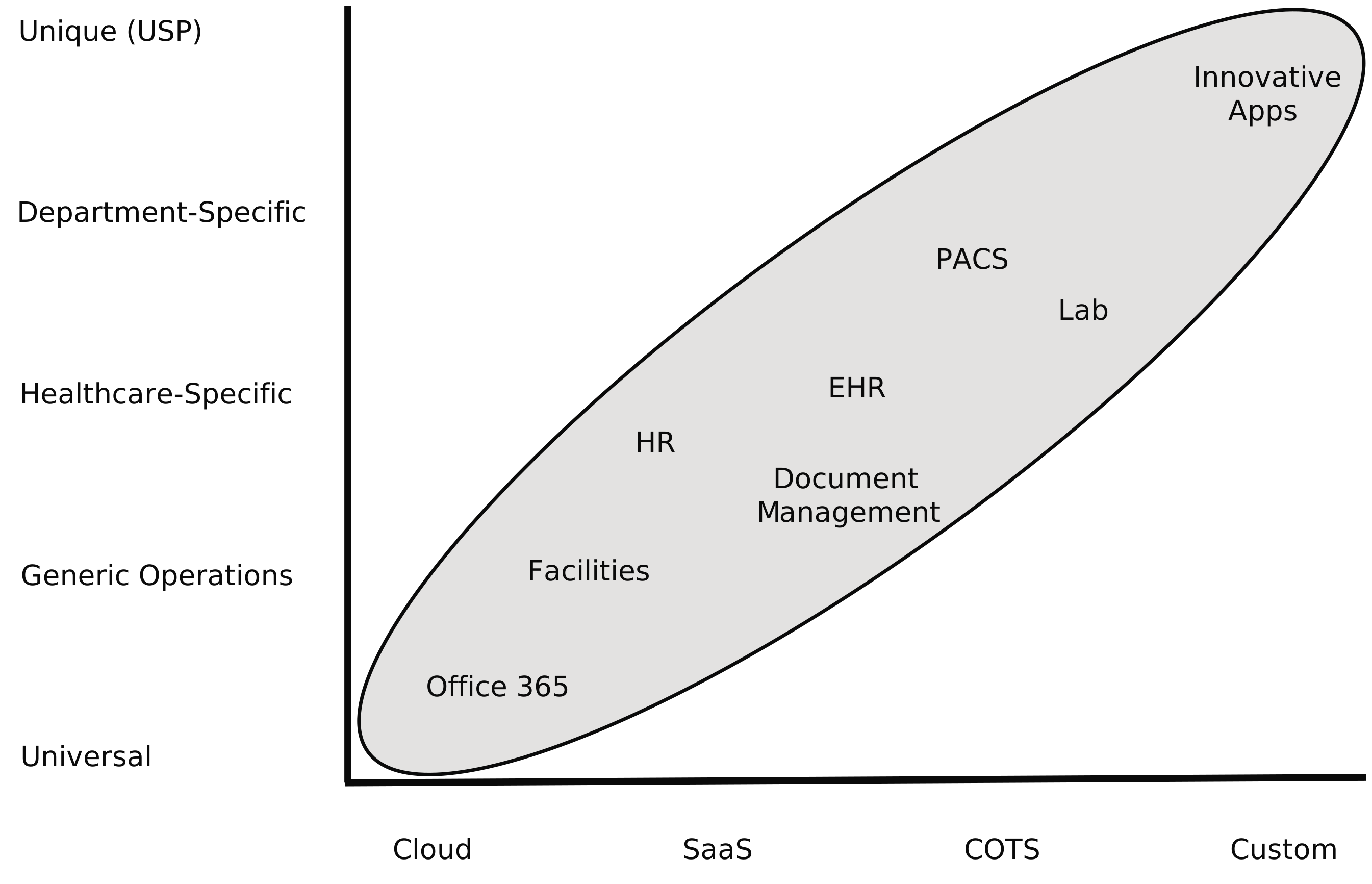
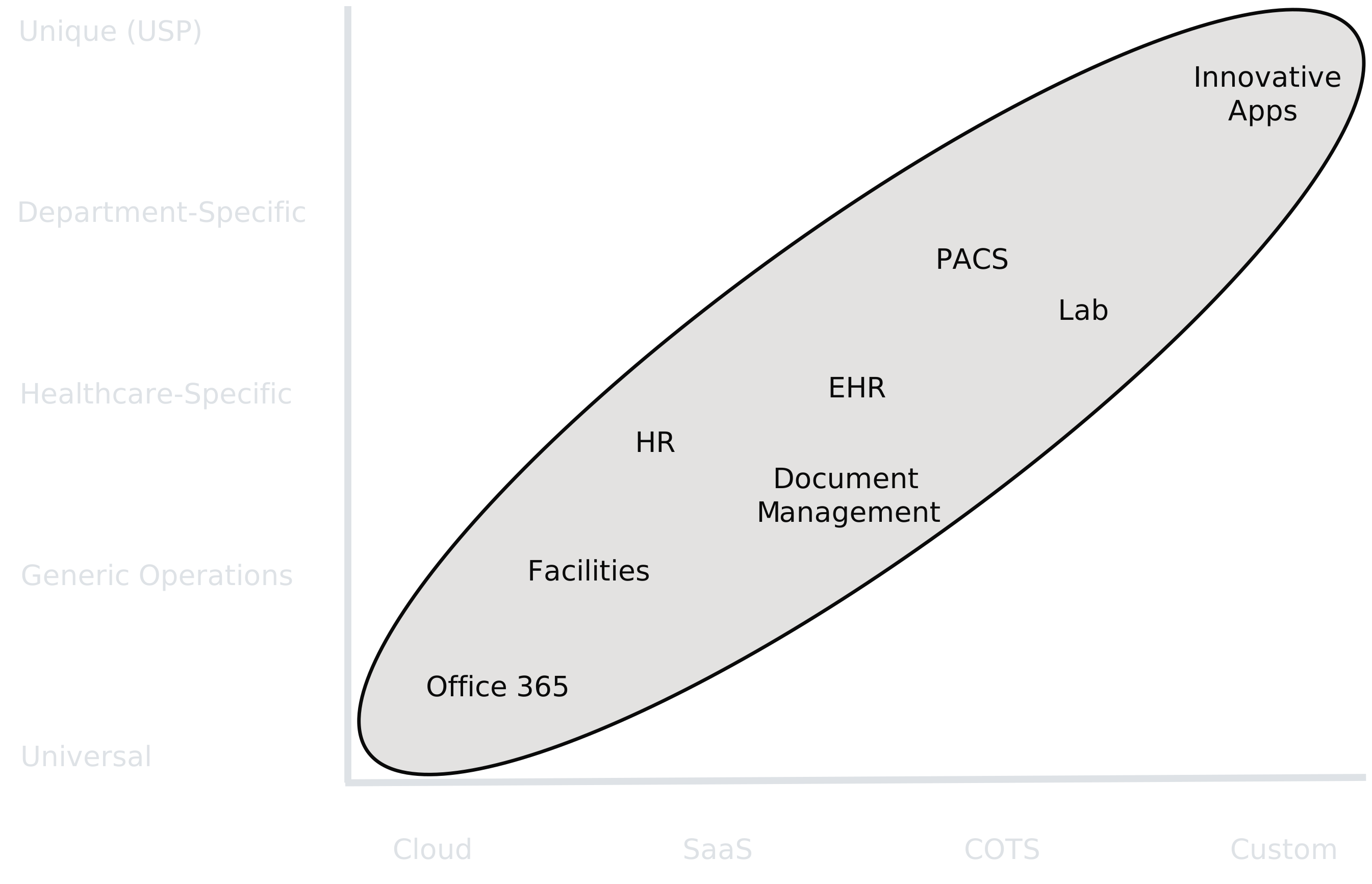
You should only custom-build what genuinely sets you apart from everyone else as an organization. And let’s be honest: how does an average hospital really differ from the one fifty kilometers down the road? On very specific specializations, perhaps. But the EHR system isn’t that differentiator. It’s just a basic utility you should standardize as much as possible.
In healthcare, you currently see everything sitting in that sector-specific layer, with a custom implementation and custom tweaks every single time. Meanwhile, financial systems and HR systems moved to SaaS long ago. That same transition needs to happen for the EHR, but as a shared service, not as seventy separate solutions.
AdaptiQ: Where do you start in practice? Rolling out a national EHR takes ten years, and the patient gets nothing out of that today.
Frauke: Start at the bottom. Start where the egos are smallest, where the playing field is least complex. Start with infrastructure and security.
If 70 hospitals can agree: how are we going to tackle data center infrastructure together? How do we set up security across our organizations? Then you don’t need to bring physicians to the table, no medical staff, no powerful specialty groups. Just CIOs who all have the same problems, and they really do. I run into them at industry events. Everyone has too little budget, too few people, too much technical debt. Everyone tells the same story.
The money you free up that way can then go into better patient care, or into the next step: thinking through together how to make EHR data more uniform. And from there, you can get a flywheel turning. But you don’t start with the hardest question. You start with the most basic, least political one.
There are examples that show this works. In the municipal world, four major Dutch cities pooled their IT for income support into a single organization: Wigo4it. In the energy sector, all smart meter data has been centralized in a single hub at EDSN. That’s quasi-governmental, not commercial, and it works. It doesn’t have to be any more complicated than that.
AdaptiQ: What is your message to a CIO or executive in healthcare who is now at the start of a digital transformation?
Frauke: Know your audience. I run training sessions for executives and supervisory board members, and I always ask them: when was the last time you actually worked alongside the people on the floor? Not sitting in on a department meeting, but really spending a day working there to see how the processes actually run? It’s striking how big the gap still is between IT and daily practice.
And be vulnerable. One of the biggest problems I see is the boardroom dynamic where IT people show up with their jargon, sometimes to position themselves as the expert, while executives understand 25% but don’t dare to ask, because they’re afraid of looking foolish. That’s a dynamic you have to break. On both sides.
Beyond that: focus on the chain of care, not on your own organization. The gain isn’t in optimizing one hospital. The gain is in connecting the GP, hospital, pharmacy, and home care. That requires ecosystem thinking. It requires a willingness to contribute to a solution that benefits your neighbor too. And that willingness is in short supply.
Finally: have the courage to start. Not with the most complex challenge, but with the most basic step. Pool your strengths on infrastructure and security. Make costs transparent. Show what it costs when everyone goes their own way. Build awareness. That’s the movement that needs to emerge, not imposed from the top down, but carried by the people who wrestle with the same problems every day.
Frauke Wessel’s message is clear: digital transformation in healthcare doesn’t stall on technology, but on fragmentation, a lack of ecosystem thinking, and an unwillingness to pool strengths. The solution isn’t one big leap, but starting at the bottom, with what’s least complex and most urgent. Infrastructure and security first. Then the rest.
Getting that flywheel turning calls for tech leaders who bring strategy, technology, and collaboration together in one integrated approach, and for partners who help accelerate the process.
Facing similar challenges in your organization or sector? AdaptiQ works with tech leaders through Digital Strategy and Program Management to turn technology and data into measurable business performance. Let’s Talk .